
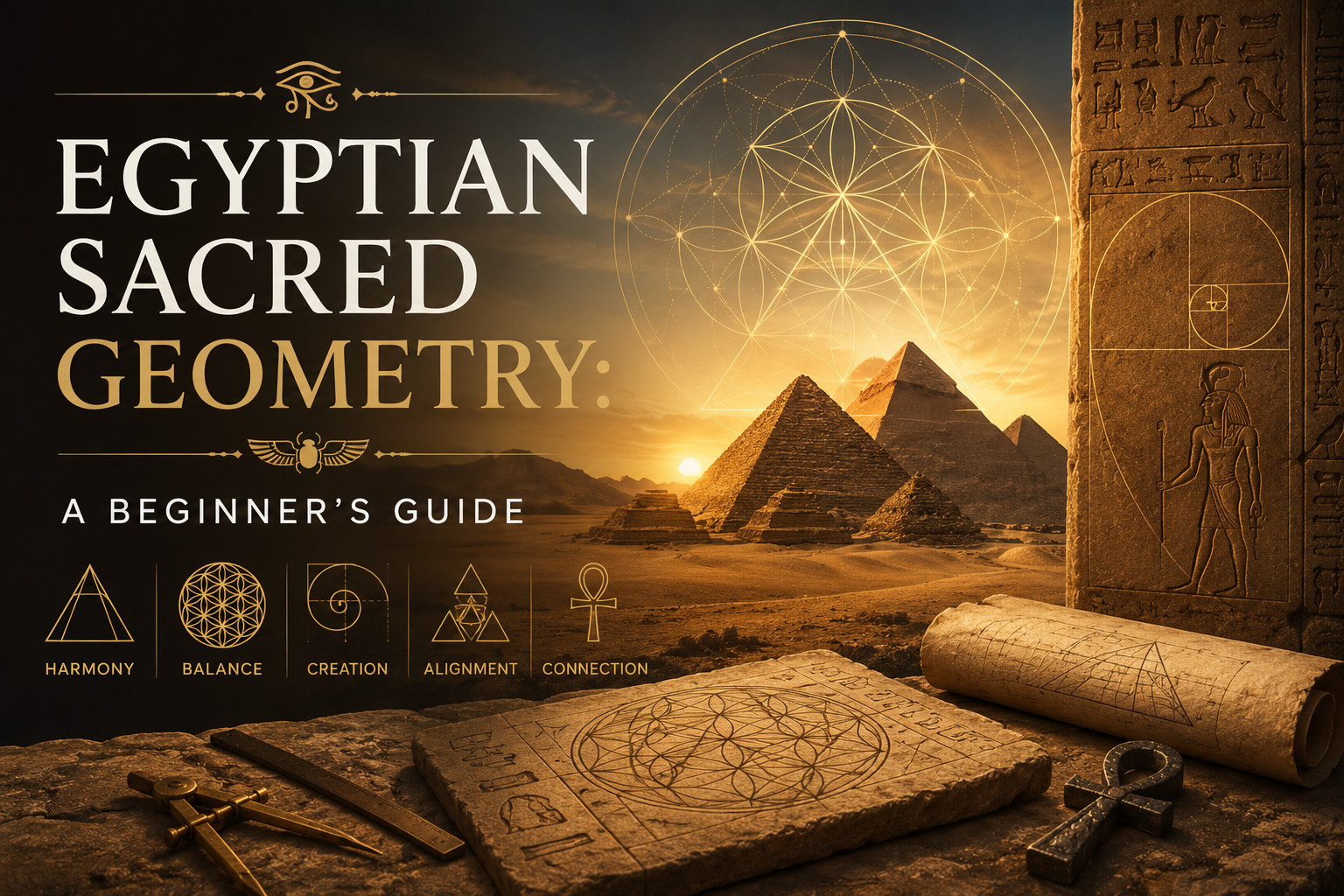
Egyptian Sacred Geometry: A Beginner’s Guide
Egyptian sacred geometry is the study of the shapes and lines used in old Egyptian temples, art, and tombs. The Egyptians did not just build pretty things. They built things by code. Each shape held meaning. Each ratio held a secret.
This guide walks you through the main patterns. You will learn the squared circle, the Eye of Horus fractions, the golden ratio, and the Flower of Life. Even a small piece of this lore changes how you see the pyramids.
What Sacred Geometry Means
Sacred geometry is the idea that some shapes hold spiritual meaning. The circle. The square. The triangle. The spiral. These show up in every old culture. Egypt was no exception.
The Egyptians used these shapes in three ways. They built with them (pyramids and temples). They drew with them (gods and tombs). They lived with them (calendars and city plans).
The Pyramid: Sacred Shape of the Sun
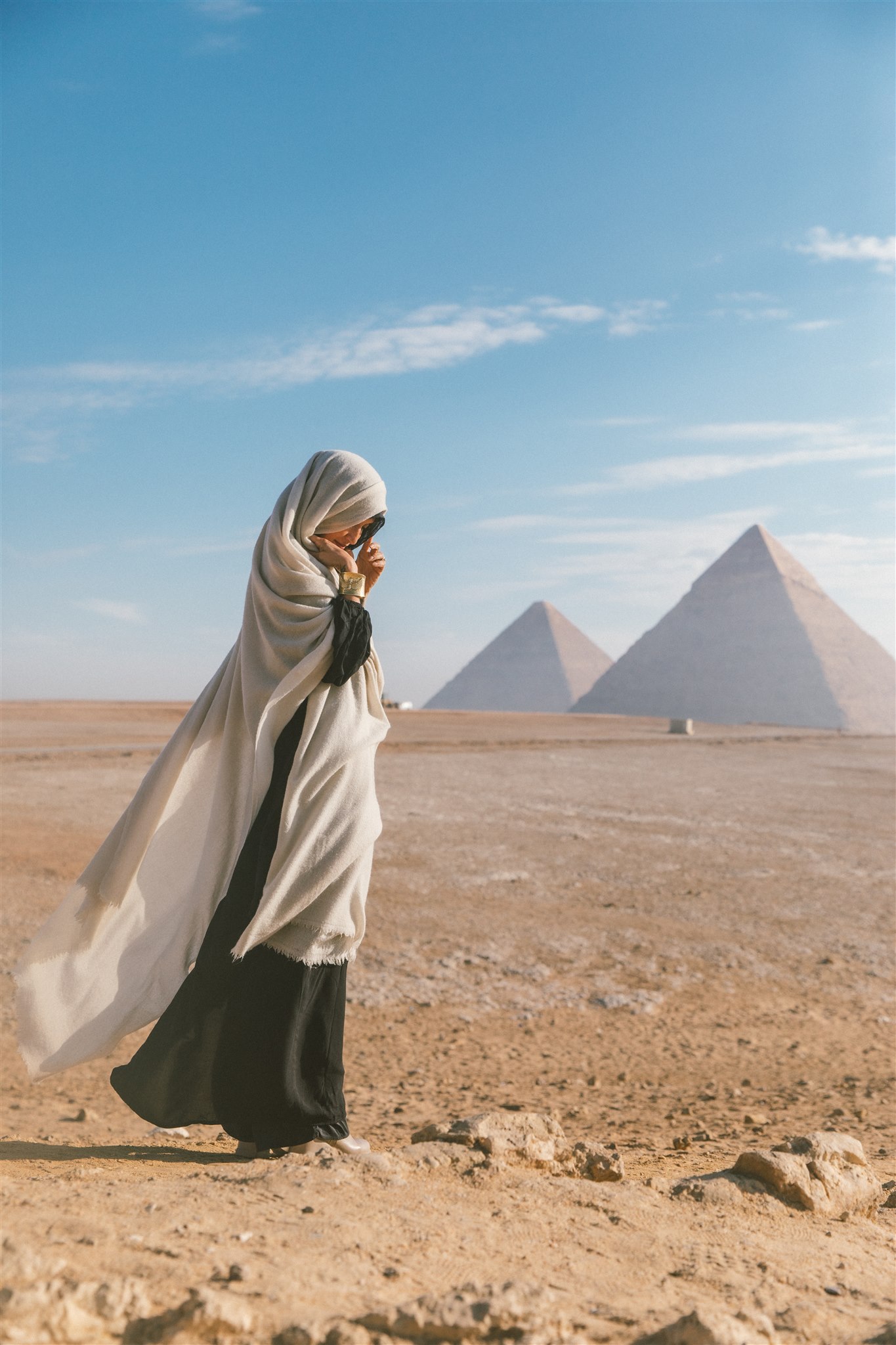
The pyramid is the most famous Egyptian shape. Its base is a square. Its faces are four triangles that meet at a point. The point reaches up to the sun.
The Great Pyramid at Giza is one of the most studied buildings on earth. Its sides line up almost perfectly with north, south, east, and west. The angle of each face is 51.84 degrees, which gives the pyramid a special ratio.
Some say the pyramid uses the golden ratio. The base divided by the height gives a number close to phi. Some say it does not. The match is close, but not exact. Egyptologists still debate this. Either way, the pyramid was built with care that we still study today.
The Squared Circle
The Egyptians used a problem called ‘squaring the circle.’ This means: draw a square that has the same area as a given circle. They got close, with a clever shortcut.
The Rhind Papyrus from about 1650 BCE has the formula. Take 8/9 of the circle’s diameter and square it. That gives the area of the circle, very close. This is one of the oldest math books on earth.
You can see this papyrus at the British Museum, where it lives today.
The Flower of Life and Egypt
The Flower of Life is a pattern of overlapping circles. It looks like a six-pointed star inside a hex grid. It shows up at the Temple of Osiris at Abydos. The pattern is not painted. It is burned into the granite stone.
How was it made? No one is sure. The marks are deep and clean. They look like they were made by some kind of laser, but no such tool existed. Some think monks of a later age burned the pattern in. Some think it was Roman-era graffiti. Some think it is far older.
Either way, the Flower of Life pattern is found in Egypt and in many other old cultures. China. India. Greece. The pattern seems to be a kind of language all its own.
The Golden Ratio in Egyptian Art
The golden ratio is a number, about 1.618. It shows up in nature, in art, and in old buildings. The Egyptians may not have called it that, but they used it.
Some Egyptian statues have heads, torsos, and legs in golden-ratio proportion. Some hieroglyph layouts use the same. We cannot prove the Egyptians knew the ratio by name. We can see they used it by feel.
If you want a wider view on patterns and rhythm in art, the Smithsonian’s design page has free articles on art proportion.
Sacred Numbers in Egypt
Every Egyptian number had meaning.
- 1 — the one creator god, Atum, the seed of all.
- 2 — duality, day and night, Ma’at and chaos.
- 3 — the holy triad: father, mother, child (Osiris, Isis, Horus).
- 4 — the four sons of Horus, the four corners.
- 7 — the seven planets, the seven gates of the underworld.
- 9 — the Ennead, nine main gods.
- 42 — the 42 nomes (regions) and the 42 confessions.
Each number was used in temple plans, in spells, and in art.
Sacred Geometry in Temple Design
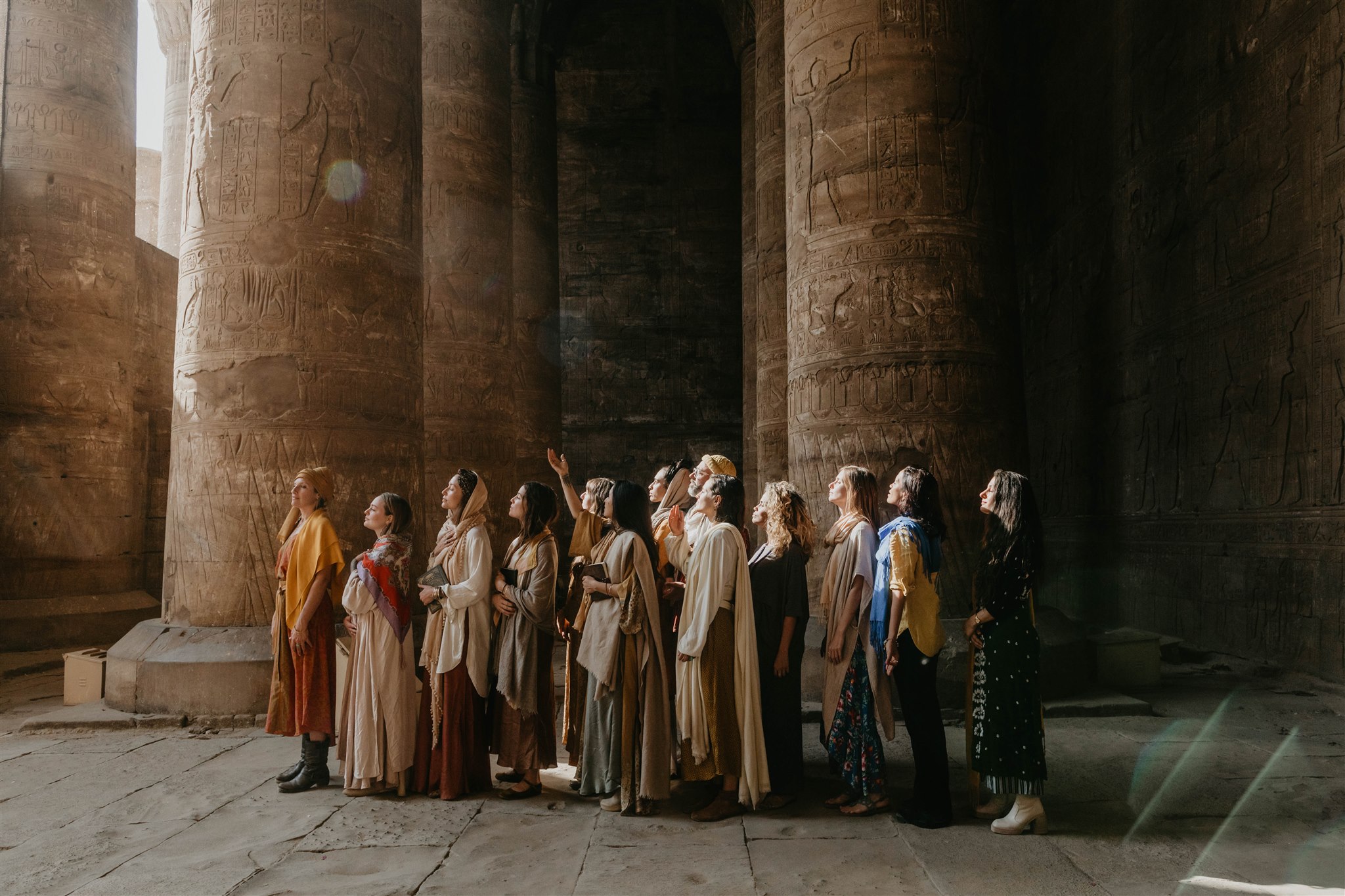
Egyptian temples followed a clear pattern. They start big at the door and get smaller as you walk in. The most holy room is the smallest. This is on purpose. As you go deeper, the world gets smaller, more focused, and more sacred.
This same rule shows up in many old temples around the world. The path from outside to inside is also a path from many to one.
If you want to walk a real Egyptian temple in person, our Egypt journeys include sites that show this pattern still in use.
Using Egyptian Sacred Geometry Today
You do not need to build a pyramid. Small daily uses:
- Draw a six-fold flower at the top of your journal.
- Place your altar in a small, focused corner of the room.
- Use the number 7 in your prayers (seven candles, seven breaths).
- Carry a small triangle stone for sun energy.
- Walk the four corners of your home each new moon.
For more on building a daily ritual, see our post on morning spiritual ritual.
Final Thoughts
Egyptian sacred geometry is a deep, old code. The shapes and numbers carry meaning that speaks across the ages. Read a temple wall. Look at a pyramid. The lines are not random. They are words in a language of stone.
If you wish to study sacred sciences as a path, our Apprenticeship offers deep training in this lineage.
Frequently Asked Questions
Did the Egyptians know the golden ratio?
Probably not by that name. Their art uses ratios close to phi, which suggests they used a system of proportions that gives the same result.
What is the Flower of Life?
It is a pattern of overlapping circles found in Egypt, China, India, and Greece. The Temple of Osiris at Abydos has one burned into stone.
Were the pyramids built with sacred geometry?
Yes. Their plans use clean ratios and align with the cardinal directions. The exact level of math the Egyptians had is still studied today.
by The Acedemy of Oracle Arts