
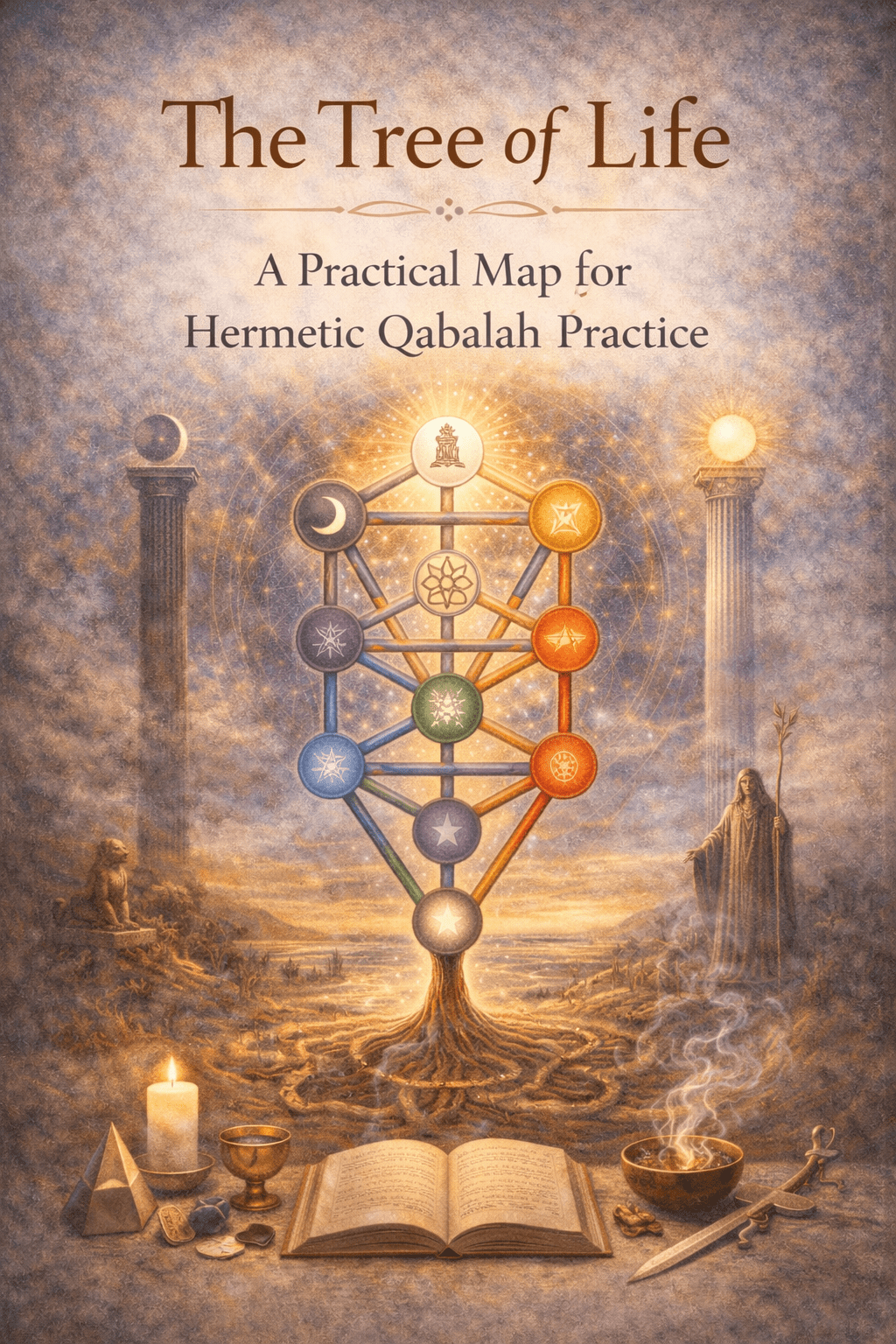
The Tree of Life: A Practical Map for Hermetic Qabalah Practice
A respect note (important)
The Tree of Life emerges from Jewish mystical traditions. Hermetic systems adapt it in modern Western esotericism. Mature practice:
- acknowledges origins
- names adaptations honestly
- avoids claiming authority over traditions not one’s own
Why the Tree of Life helps in daily life
Most people struggle in one of two ways:
- vision without action
- action without clarity
The Tree of Life helps you locate where the “block” is:
- Is the issue intention? (unclear purpose)
- Is the issue balance? (ethics, boundaries, relationships)
- Is the issue embodiment? (follow-through and real-world structure)
A simple way to use the Tree as a decision tool
When facing a choice, ask three questions:
1) Intention: What is the real motive here? 2) Impact: Who is affected and what are the consequences? 3) Embodiment: What is the smallest responsible step I can take now?
This keeps the Tree practical and prevents spiritual abstraction.
A 7-day Tree of Life journaling practice
- Day 1: write your current life question (one sentence).
- Days 2–6: each day, answer one lens:
– “What is my intention?” – “What boundary is needed?” – “What is the next action?” – “What pattern repeats?” – “What repair is required?”
- Day 7: review and choose one commitment for the next week.
Common mistakes
- Treating the Tree as a status ladder (“higher is better”)
- Collecting correspondences without integration
- Using the Tree to bypass relationships and responsibility
Study pathways with the Academy
To study the Tree of Life as lived practice:
- Explore related offerings in Classes & Courses.
- Build consistency through Self-Study Courses.
- Meet the Academy’s teaching field through Instructors.
- For long-form integration of sacred sciences, ritual, and oracular work, explore the Oracle Arts Apprenticeship.
by The Acedemy of Oracle Arts